
Custom sawmilling
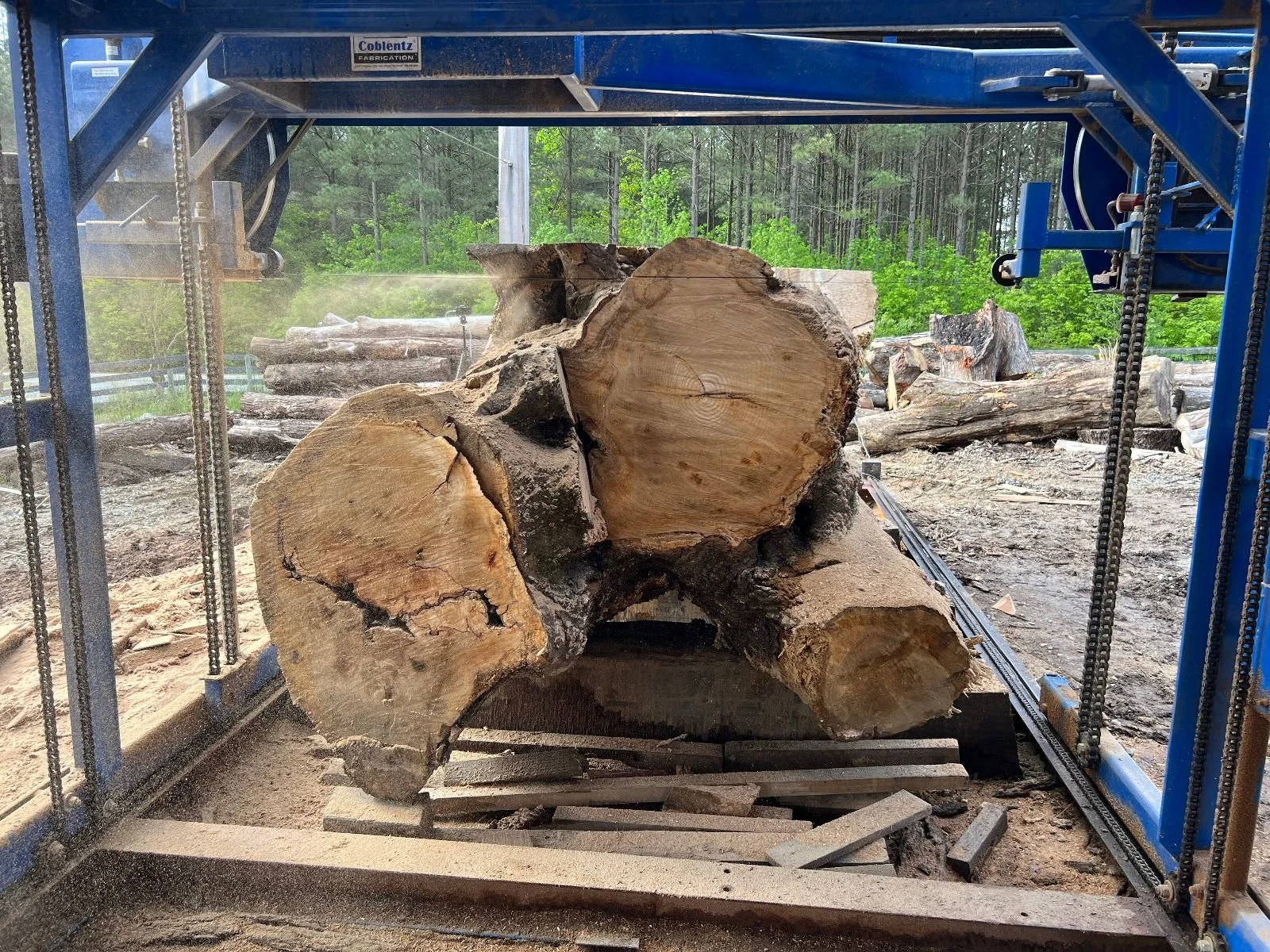
Don't burn that tree. Mill it.
The tree came down yesterday — now what? Once the tree service hauls it away, it's gone for good.
A storm-felled oak or a walnut removed for construction doesn't have to become firewood. Bring us the log — or have us pick it up — and we'll mill it into slabs, mantel stock, or dimensional lumber to your cut list. Many customers then have us kiln-dry the boards and even build the final piece.
How a milling day works
01
Send us photos of the log
Text a photo with something for scale to 919-505-1887. We'll confirm it's millable and estimate yield.
02
Deliver — or we pick up
Bring the log to the farm, or we'll transport it for $200/hr with our trailer and grapple.
03
We mill to your cut list
Slabs, boards, beams, mantel stock — you decide thickness and we saw accordingly.
04
Optional: dry it in our kiln
Most projects need dry wood. Move straight from mill to kiln — see kiln drying.
Pro Tips:
- Max log size: 8' diameter × 20' long.
- We run two mills. Big Blue is an 8-foot-wide bandsaw — the widest in North Carolina — for ultra-wide live-edge slabs; Little Red handles dimensional lumber and quarter-sawing. Giant logs get quartered on Big Blue, then finished on Little Red.
- Every job includes a blade fee — $50 on Little Red, $95 on Big Blue. Metal in yard trees is common and ruins blades, so we scan every log first.
- Green (fresh-sawn) lumber must air- or kiln-dry before fine woodworking — plan 1" per year air, or weeks in our kiln.
- Slab flattening on our router sled handles slabs up to 5' wide and 18' long.
- We load pickups with a skid steer — no crane — so logs need to be reachable by ground equipment. Not sure about access? Text us photos.
Live, plain, quarter, or rift?
Tell us the look you're after — we saw all four cuts.
Live sawn (slabs)
Sliced straight through, end to end, natural edge intact — how Big Blue cuts our live-edge slabs. Each slab carries the log's full range of grain.
Plain sawn
Growth rings 0–45° to the face. The most efficient, most affordable cut, with classic cathedral grain — a bit more prone to cupping.
Quarter sawn
Rings 75–90°. The log is quartered, then sawn — very stable, straight grain, and dramatic ray-fleck figure in white oak. Lower yield, higher price.
Rift sawn
Rings 45–75°. The straightest, most uniform grain on every face — prized for table legs and modern designs. Wastes the most wood, so it costs the most.